One-to-one, live
Every correction happens in the moment, with a teacher who knows your progress.
Real teachers. Real-time correction. A lesson plan that responds to you—not another library of videos. Learn music, voice, movement or art live from Chennai, wherever your clock happens to be.
Match my timezone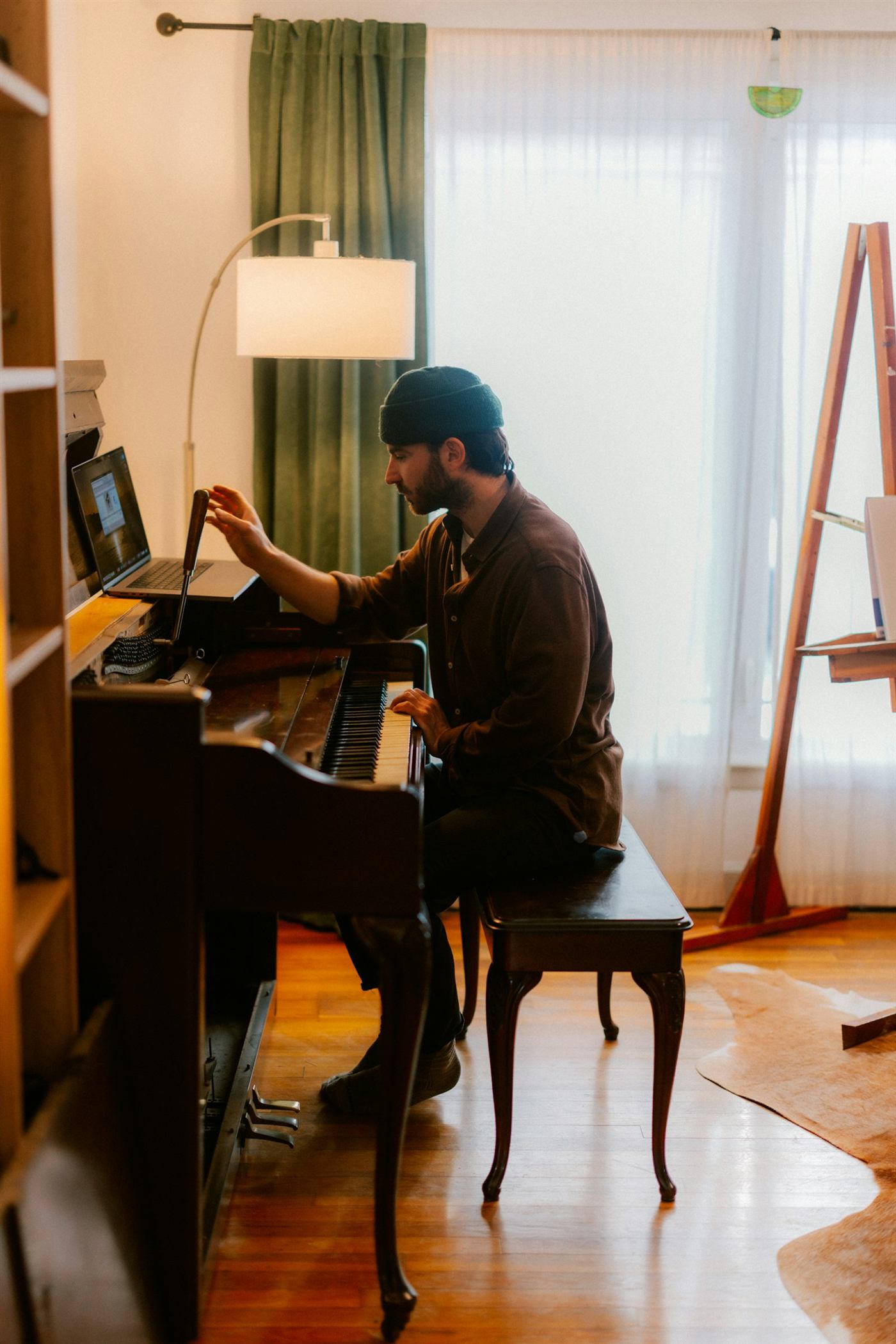 Brooks teacher · live
Choose where you are. We translate three popular after-school Chennai slots into your local time so you can arrive at the trial request with a schedule that already makes sense. These are only the most common timezones — we teach students in every country and every Indian city, so tell us yours and we will work to it.
A video call is only the cable. The lesson works when demonstration, student sound, correction and the between-class plan each have a clear route. Select a channel to trace what the teacher needs to see or hear—and why setup is adapted for different disciplines.
Piano may need hands and keyboard; guitar may need both fretting and posture; dance needs a safe full-body frame; art needs the work surface. The teacher can help refine the angle during a trial.

Piano, keyboard, guitar, violin, drums and theory—taught live with camera angles that make technique easy to see.
Explore music →Every correction happens in the moment, with a teacher who knows your progress.
Trinity College London and Rockschool goals remain available wherever you log in.
Camera setup, material lists and technique are adapted to the space you have.
Families learn with Brooks across the Gulf, Asia, Europe, Australia and the Americas.
A short check confirms that the relevant instrument, body position or working surface is visible and that instructions can be heard comfortably. Setup problems are solved before they consume the learning task.
The learner performs or demonstrates a small piece of recent work. The teacher listens for what has stabilised, what is inconsistent and what the learner already knows about the cause.
A camera can move when necessary. A hand shape, breath release, foot pattern or brush action is isolated, modelled and compared from an angle that makes the mechanism clear.
The detail returns to repertoire, choreography or a project. The teacher varies tempo, prompt or starting point so the learner can reproduce the improvement rather than accidentally achieve it once.
The close identifies a manageable priority, useful material and what success should sound or look like at home. Younger learners may involve a parent in this handover.
Start with the device and connection you already have. During the trial, the teacher can identify the one setup change with the greatest learning value rather than prescribing unnecessary equipment.
Online learners follow a developing programme rather than isolated calls. Repertoire, exercises, creative tasks and teacher observations form a thread from one lesson to the next. Families can ask what the present focus is, what evidence of progress to look for and when a goal should be refreshed.
When certification is useful, Trinity College London or Rockschool pathways may be discussed for relevant disciplines. A teacher should first consider readiness, motivation and whether the syllabus strengthens the learner’s broader musicianship. Performance can also mean a recorded project, an informal sharing or playing for family—not only an examination.
Online lessons are a strong fit for learners who can respond to live instruction in their own space, have a workable device connection and value access or continuity. Younger learners may need an adult nearby for setup and handover. If a physical adjustment cannot be understood clearly through demonstration and camera angles, a studio lesson may be the better recommendation.
Request a live trial ↗No. Classes are taught live, so the teacher can listen, observe and change the task in response to the learner’s attempt.
Teacher and learner generally avoid trying to perform simultaneously over the call. Instead they use alternating demonstration and response, counted entries, backing references and visual pulse where useful.
Yes in many disciplines. Suitability depends on age, setup and the kind of physical feedback required. A trial gives better evidence than a blanket rule.
The exact method depends on the course and teacher. Ask during the trial how repertoire, lesson notes or project references will be organised for your programme.
Online learning can support continuity across travel or relocation, subject to arranging a mutually workable time. Confirm individual scheduling needs directly with the team.
Yes. Brooks teaches live online from Chennai to families across the Gulf. Saudi Arabia, Bahrain, Kuwait and Qatar use UTC+3, while the UAE and Oman use UTC+4; tell us your city and we will match a practical lesson time.
Yes. Carnatic and Western vocal lessons are taught live online, alongside piano, keyboard, guitar, ukulele, violin, drums and music theory. The teacher adapts the lesson to the learner’s level, goals and home setup.
Brooks Musicals teaches live online across India and worldwide. You do not need to find a page for your exact city: tell us your country, city and preferred time, and admissions will match a practical slot. The region cards are a simple starting point, not a limit on where we teach.
One regional route for piano, guitar, keyboard, drums, violin, Western vocals, Carnatic vocals and music theory. Saudi Arabia, Bahrain, Kuwait and Qatar are UTC+3; the UAE and Oman are UTC+4.
See Gulf timings and classes →Live lessons from Chennai for learners in Bengaluru, Hyderabad, Mumbai, Delhi, Kolkata, Kerala, Sri Lanka and beyond—without a commute to a branch.
Browse the courses →Reach families in New York & New Jersey, Chicago, San Francisco, San Jose, Dallas–Fort Worth, Washington, DC, Los Angeles, Houston, Atlanta and Philadelphia through one useful US route. US learners can also request an ABRSM-focused theory and exam-preparation plan.
See US timings and classes →Eastern, Central and Western Australia each get clear scheduling guidance, with Sydney, Melbourne, Brisbane, Adelaide and Perth included as audience hubs—not separate city pages.
See Australia timings and classes →Families in the UK, Singapore, Malaysia, New Zealand and any other country can enquire. A live teacher, a workable connection and a suitable time are the only starting points.
Find your time window ↓Not seeing your country? That is expected. We intentionally keep this page regional and calm instead of publishing hundreds of near-identical city pages. Send your location through the free demo request and we will work from your exact timezone.